For anyone whose game shelf is mostly decoration.
A five-year-old can play it.So can a world champion.Same board, same game, same night.
There is one game that does this, it has been quietly doing it in rural Ontario since 1876, and almost nobody in the States has heard of it. I build the boards.

Already know crokinole and just want the numbers? Skip to the spec.
A handcrafted crokinole board. $185.
Crokinole is a Canadian tabletop game from the 1870s: you flick wooden discs across a polished 26 inch board, aiming for the recessed hole in the middle. It takes one sentence to teach and about thirty seconds to learn.
This is a made-to-order board built to the tournament dimensions, with 24 discs. Order one or read the spec.
If that is all you needed, good. The rest of this page is why I think it is the best game there is for a room full of people who are not all the same age.
You have a shelf of games. Be honest about how many of them you actually play.
There is the one everybody likes, which needs exactly four people, and you have five. There is the good one that takes twenty minutes to set up before anybody gets to do anything. Somewhere behind it is the one your friend swore by, still in the shrinkwrap, eighteen months later. And there is the party game you are quietly embarrassed to own.
So the night comes. Somebody says "we should play something." Everybody looks at the shelf.
And then everybody looks at their phone.
It is not that your people do not want to play. I want to be clear about that, because it is easy to decide your friends have gotten boring, and they have not.
The problem is that picking is work and learning is work. Somebody has to volunteer to be the person who reads the rules out loud. That person then explains for six minutes while two other people drift toward the kitchen. By the time the first turn happens, half the table has emotionally checked out, and the game they are about to play is one where the person who read the rules is going to win.
Then there is the range problem, which is worse and which nobody talks about.
Your nephew is nine. Your mother-in-law is seventy-two and does not care for anything with a timer. Your friend from work plays board games competitively and will absolutely optimize the fun out of this. These are the actual people in your actual living room, and almost every game on that shelf was designed for a table where everyone is roughly the same person.
So you compromise. You pick the game that nobody hates. Which is a real category, and it is not the same as a game anybody loves.
Here is the part that got me.
It is not one disappointing evening. One evening is fine. It is that this happens the same way every time, four or five times a year, for years, and each one is a night you had all the right people in one room and spent it half-watching something instead.
Count them up over a decade. That is fifty gatherings.
The specific sound of it is what I notice now: a room with eight people in it and nobody talking, because everyone is scrolling in parallel. Nobody is unhappy. That is somehow the worst part. Everyone would tell you they had a nice time.
I am not writing this as somebody who solved it early. I have that shelf, and I bought most of those games for exactly this reason, and every single time I told myself the next one would be the one that finally stuck.
It took me an embarrassingly long time to work out that I was solving the wrong problem. I kept auditioning games, when the thing I actually needed was a game that did not hold auditions.
I found this one the way most Americans find it, which is by accident, at somebody else's house, and then thinking about it for a week afterward.
The problem was never which game. It was that games ask everyone at the table to be the same person.
Almost every game solves for players of similar skill and similar attention. When they are not similar, you get one of three bad outcomes: you dumb it down, you invent a handicap, or somebody quits. The mixed table, which is most tables, has no good option.
Crokinole does not have this problem, and it is the only game I have found that genuinely does not.
Here is the entire tutorial. You put a disc on the board on your side. You hold your finger against your thumb, and you snap it forward, and the disc slides toward the middle. Land it in the recessed hole in the center and that is twenty points.
That is it. That is the whole thing. Thirty seconds and a nine-year-old is playing.
And then here is the other half, which is why it survived 150 years. Snapping a disc is instantly available to anybody. Snapping a disc exactly where you want it, through a gap between two pegs, with enough weight to knock an opponent off and enough control to stay on yourself, is a skill you can spend forty years getting better at. There is a world championship for this. People train for it.
Both of those are true at the same time, on the same board, in the same game.
So the nine-year-old and the person who has played since 1988 sit down across from each other, and the nine-year-old is not being let win, and the adult is not bored, and it is genuinely close. A single lucky flick can undo a decade of practice. The expert still wins more often. Both of those facts are what make it work.
It is quiet, and a game runs twenty to forty minutes. You can play it with a drink in your hand and a conversation going the whole time, and then somebody threads a disc through the pegs and the conversation stops for a second.
Nobody puts it down. That is my honest opinion after making these and watching people play on them, and I would rather say it as an opinion than pretend a thousand strangers said it for me.
If that is already enough, here is the board.
Order a boardNot wired up yet: this page needs a real order link before it goes live.
$185. Built to order in LEAD_TIME. GUARANTEE_SHORT
Crokinole has been around since 1876. You have just never met it.
In 1876, a man named Eckhardt Wettlaufer, in Sebastopol, near Tavistock, Ontario, built a board for his son Adam's fifth birthday. Adam was born on the last day of 1871. That board still exists. It is in the Joseph Schneider Haus Museum in Kitchener, Ontario, and it is the oldest crokinole board anybody has found.
The interesting part is what it implies. Wettlaufer did not invent the game. He clearly already knew it, which means crokinole was already circulating in 1876 and the oldest surviving board is just the oldest one that happened to survive.
Historians trace it back to a mix of older games: British squails and shovelboard from the 1500s, and carrom, which came from India and Burma. It spread through rural Canada and the northern states in the late 1800s, and it took hold hardest in Mennonite and church-hall communities, which is exactly the kind of place where a quiet game that a whole family can play at once would take hold.
In French-speaking areas they call it pichenotte.
Then in 1999 the town of Tavistock started the World Crokinole Championship. It runs every year on the first Saturday of June, and there is now a real competitive scene around it.
So: a hundred and fifty years, one museum piece, an annual world championship, and a French name. It is not obscure. It is Canadian.
What makes a crokinole board good, and what makes one bad
Two things make or break a crokinole board. Most boards get at least one of them wrong, and I will tell you what they are in a minute.
Start with the surface, because it is the one that matters most and the one that is easiest to fake. A crokinole board is finished for speed, not for grip. Mine gets sanded up through 220 grit, then knocked down with 0000 steel wool until it is glassy, then finished thin and buffed, then waxed with powdered shuffleboard wax.
The target is simple to state and annoying to hit: the surface should feel like ice, not wood.
You notice it immediately. On a fast board a disc you barely touch will travel the whole 26 inches and settle. On a slow board it dies at the halfway ring and the game becomes a shoving match. Same rules, completely different game.
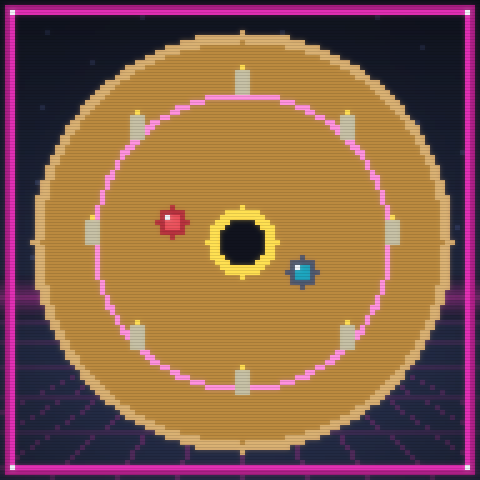
The geometry. The playing surface is a true 26 inch circle. The rings get scribed from one fixed center point, so the peg circle and the scoring zones stay concentric and scoring is never a judgment call. Around the outside there is a 2 inch recessed ditch to catch anything that slides off, and a raised rim to keep the overshoots off your floor. Total diameter about 30 and a half inches, so it sits on a normal dining table with room to lean on.
Eight pegs, hardwood dowel, standing 5/8 of an inch proud, set 45 degrees apart. There is no official peg height, and my published plan gives a range because a range is the honest answer for somebody building their own. On a board I sell you it is 5/8, every time, because you should be able to practice a shot on my board and have it work the same way next year. The gaps between the pegs are the whole game. Threading a disc through one into the 20-hole is the shot that makes people yell.
Then the hole in the middle, which is the part people never think to ask about: one and three eighths across, recessed exactly a quarter inch, flat-bottomed, with a slightly rounded lip so a disc drops in and lies flat instead of sitting proud and starting an argument.
The discs. Twenty-four of them, twelve per side, an inch and a quarter across and three eighths thick. DISCS_INCLUDED

The spec: every number, checkable
Every one of these is checkable when it arrives. Bring a tape measure, I do not mind.
The two that matter most are not mine. A tournament board under the National Crokinole Association standard is a 26 inch playing surface with a 2 inch ditch around it, and that is what this is. I did not pick 26 inches because it looked right. I picked it because it is the number every serious board in Canada is built to, and because a disc that behaves correctly on a 26 inch surface behaves wrong on a 24 inch one.
| Part | Spec |
|---|---|
| Playing surface | 26 in (66 cm) true circle, flat. NCA tournament standard. |
| Total diameter | ~30.5 in (77.5 cm) including ditch and rim |
| Ditch | 2 in (51 mm) recessed gutter. NCA tournament standard. |
| Rim | 1/4 in (6 mm) raised lip |
| 20-hole | 1 3/8 in (35 mm) across, recessed 1/4 in (6 mm), flat bottom |
| Pegs | 8 hardwood dowel, 3/8 in (9.5 mm), 5/8 in proud, 45° apart |
| Scoring rings | 8 in / 16 in / 24 in diameter, ~1/16 in line width |
| Surface prep | Sanded to 220 grit, then 0000 steel wool |
| Finish | Thin film finish buffed smooth, then powdered shuffleboard wax |
| Discs | 24 total, 1 1/4 in x 3/8 in, 12 per color |
| Materials | WOOD_SPECIES |
| Surface panel | PANEL_CONSTRUCTION |
| Weight | BOARD_WEIGHT |
| Players | 2 or 4 (head to head, or two teams of two) |
| Game length | 20 to 40 minutes |
So, the two things that make or break a board: a dead-flat fast surface, and a 20-hole at exactly a quarter inch deep. Everything else you can be a little off on and still have a good time. Those two you cannot.
I published the full plan for this board, free, before I sold one
I am not going to tell you I have been doing this for thirty years, because I have not.
Here is what I will tell you instead. The complete plan for this board is on my site right now, free, no email required. Materials list, cut list with every dimension, eight build steps, and a closing note on the two things that make or break it.
Go read it. Seriously, open it in another tab.
If you own a router and a trammel arm and you have two decent weekends, build your own and do not pay me a dollar. I would genuinely rather you did that than buy a bad board from somebody else.
I put it up because the alternative was hoping you never asked. Anybody can write "quality construction" on a product page. Very few people will publish the number that lets you check them, because the number is where you get caught. A quarter inch on the hole depth is a real commitment. If mine came in at three eighths you would be able to tell, and you would have it in writing.
That is the whole credential. I know what makes these good, I wrote it down where you can see it, and then I build to it.
Have one builtNot wired up yet: this page needs a real order link before it goes live.
$185, made to order, LEAD_TIME.
Who this is for, and who it is not
Get one if:
- You host, and you have been looking for the thing that works on a mixed table
- You have kids and adults who want to do the same thing at the same time
- You like objects that will outlast you
- You already know crokinole and you have been putting off buying a decent board
- You want a gift that gets used more than once
Do not get one if:
- You need it this week. These are built to order. LEAD_TIME_PLAIN
- You want the cheapest board that technically qualifies. That board exists and it is not mine.
- Your table is smaller than about 32 inches across. This thing needs room.
- You are looking for something with a lot of pieces and a rulebook. This is a board, some discs, and one sentence of instruction.
That fourth one is not a joke. Some people want depth to look like depth. Crokinole hides all of its depth inside a very boring-looking object, and if you want a game that impresses people on the shelf, this is not it. It impresses them at the table.
The four questions I would ask before buying a $185 board
"I can get a crokinole board for sixty bucks."
You can, and here is what usually happens with it. Nothing dramatic. It does not break.
The surface is finished for looks instead of speed, so discs die halfway across and every shot becomes a hard shove. The hole is too shallow, so discs sit proud in it and you spend part of every round arguing about whether that one counts. The rings were laid out from more than one center point, so scoring near a boundary is approximate. And the whole thing has a slight cup to it, because it was not made flat and then kept flat.
None of that is visible in a photo. All of it is visible in the second game. So it gets played twice, and then it lives behind the couch.
Cheap is fine when the cheap version does the same job. Here it does a different job.
"Will we actually play it, or is this another shelf game?"
Fair, and I cannot prove this one to you, which is exactly why the guarantee below is written the way it is. What I can tell you is the mechanism: the reason games end up on the shelf is that starting them costs something. This one costs nothing. It is already set up, the rules take one sentence, and anybody who walks past can join the next round.
"Why is it only $185 when the good ones are $299?"
Because there is one of me, there is no shop taking a cut, there is no warehouse, and nothing gets built until somebody orders it. The $299 boards are not ripping you off. They are usually paying for a storefront, or shipping across a border, or both. If I ever have to hire somebody or rent space, this price goes up, and I will say so rather than quietly build a worse board.
"I have never heard of this game and now I am suspicious."
Reasonable. Go watch three minutes of the World Crokinole Championship on YouTube and come back. I will wait. That is the fastest possible version of this argument and it works better than another paragraph from me.
If you are buying this as a gift
A lot of these are presents, so, the practical stuff up front.
It ships in LEAD_TIME. To have it by GIFT_DEADLINE_OCCASION, order by GIFT_DEADLINE_DATE. SHIPPING_TERMS
It arrives looking like what it is. There is no plastic clamshell and no branding across the playing surface. It is a wooden board, and the first thing people do when they see one is put a hand on it.
One warning, from experience: whoever you give it to is going to want to play immediately, so do not hand it over on the way out the door.
$185, and why it is not $299
Three ways to think about that, and then I will stop.
Against the good boards: a handmade maple tournament board from an established shop runs about $299 before shipping, and a lot of them ship from Ontario, which adds freight and a customs form. That is a fair price and those are good boards. Mine is $185 because of the next paragraph, not because it is built lighter.
Against the cheap boards: a $60 board that gets played twice cost you $30 a game. Mine has to last three evenings to beat it, and it will last longer than I will.
Side by side, since two of you are going to build this table anyway:
| Mass-market, ~$60 | Mine, $185 | Handmade shop, ~$299 | |
|---|---|---|---|
| Playing surface | Often 24 in or unstated | 26 in, NCA standard | 26 in, NCA standard |
| Surface speed | Finished for looks | Finished for speed | Finished for speed |
| Stays flat | Sometimes | Built flat, kept flat | Yes |
| Made when | Warehoused | After you order | Varies |
| Ships from | Amazon | WORKSHOP_LOCATION | Often Ontario |
| Discs | Usually included | 24 included DISCS_INCLUDED_SHORT | Sometimes extra |
Against building it yourself: the plan is free and it is right here. Materials will run you DIY_MATERIALS_COST and it will take two weekends if things go well. That is a completely legitimate option and I am not going to pretend otherwise. What you are paying me for is the two weekends, the router, and the fact that I have already made the mistakes.
What shows up
- The board: 26 inch surface, ditch, raised rim, eight pegs, rings scribed true
- 24 discs, twelve per side DISCS_INCLUDED_SHORT
- The full build plan, which is free anyway, and which is also the spec I built yours to
- Made by one person, after you ordered it
No bonus stack, no bundle, no "normally $400." It is a board and it costs $185.
Play it first
Put it on the table. Have people over. Actually use it.
If it does not become the thing you reach for, send it back within GUARANTEE_DAYS days and I will refund you in full. GUARANTEE_SHIPPING_TERMS
I wrote it that way on purpose. A guarantee against arriving broken is not worth much, because it almost never arrives broken. The thing you are actually worried about is that it turns into another object you own, and the only way to find that out is to have four people over on a Saturday.
So that is the window. Not "inspect it and decide," but "use it a few times and decide."
Order my boardNot wired up yet: this page needs a real order link before it goes live.
$185. Built to order in LEAD_TIME. 24 discs. GUARANTEE_SHORT
Crokinole questions people actually ask
How big is it, really? About 30 and a half inches across and it needs a table a bit bigger than that. It stands up against a wall or slides under a couch when you are done. It is not small, and there is no version of this that is small, because the 26 inch surface is what makes the shots work.
Do I need a special table, or one of those spinning bases? A normal dining table works. You want something a bit wider than 32 inches so people can rest their forearms. The spinning bases (a lazy susan under the board) are a real thing and some people love them, because it means nobody has to walk around the table between rounds. You do not need one, and I do not build them in.
How many people can play? Two, or four in teams of two sitting across from each other. Four is the better version. More than four and people rotate in, which works fine and is how it usually goes at a party.
How long does a game take? Twenty to forty minutes. Rounds are much shorter than that, so it is easy to stop, and nobody ever does.
Do you have to be good at it for it to be fun? No, and this is the part people do not believe until they play. Bad shots are funny and good shots are satisfying, and a total beginner will land a 20 in their first game by accident and lose their mind about it.
Is it hard to learn? One sentence: flick your disc toward the middle, and if your opponent has a disc on the board you have to hit one of theirs. Everything else you pick up while playing.
What wood is it? WOOD_SPECIES
Can I get a custom finish or colors? CUSTOMIZATION_ANSWER
How do I take care of it? Keep it out of direct sun and off a radiator, same as any wooden thing. Wipe it with a dry cloth. Every so often it will want fresh wax, which takes five minutes, and I will tell you exactly what to buy.
Where do you ship? SHIPPING_REGIONS
Two versions of next winter
In one of them, nothing changes. The shelf gains one more box. People come over in December, everyone is glad to see each other, and by nine o'clock the room is quiet and lit by six phones. It is fine. It is genuinely fine. You will not even remember it, which is sort of the point.
In the other one, there is a board on the table when they arrive. Somebody picks up a disc without being asked, because a round object on a round board is self-explanatory. Your nephew beats your brother-in-law and will not stop talking about it. At eleven, somebody who said they were leaving at nine says "okay, one more."
That is the entire difference, and it costs $185.
Order a boardNot wired up yet: this page needs a real order link before it goes live.
$185, built to order, GUARANTEE_SHORT
P.S. The thing I would tell a friend: this is the only game I have found where a nine-year-old and an adult who has played for thirty years can sit down together and have a real match. Not a nice-of-you-to-let-me-win match. A real one. Everything else on this page is detail.
P.P.S. If you would rather build your own, the full plan is here, free, with every dimension I use. I would rather you had a good board than my board.
Play Moehr Games. Built in WORKSHOP_LOCATION by one person. Terms · Privacy · CONTACT_EMAIL